 Deutsch
Tradition
Gustav Mahler
Anton Braun
Instrument making since 1896
c.1912
The "Anton Braun" workshop was founded in 1896 by violin maker Anton Braun (1877–1927) in Temesvár, which was then part of the Austro-Hungarian Empire. He had previously learned the craft from his brother Johann Braun (1860-1922) who was 17 years his senior, in Szeged.
Anton Braun had two sons: The firstborn,
Johann Bruno Braun (1905–1968), learned the violin-making craft from his father. After the birth of the second son, Anton Michael Braun (1911–1978), , the parents decided to expand the business to include other instrument groups in order to offer the second-born a secure future in the company as well. For this purpose, they expanded the violin-making workshop with retail premises and opened a music shop. In addition to trading wind instruments, this shop also offered the appropriate maintenance and repair services in the in-house workshop.
1926
When he returned from this journey later that year—his father having already passed away the previous year—he took over the wind instrument division of the family workshop, while his older brother Johann Bruno continued to manage the violin-making department.
To ensure the business remained competitive for the future, Anton Michael took on dealerships for numerous leading manufacturers and modernized the workshop so completely and comprehensively that any type of service for these instruments became possible. The company grew dynamically during the 1930s and 1940s, expanding to include several retail branches and adding wholesale operations to their retail business.
At times, up to 40 people were employed: 20 to 25 in the workshop and 15 in the commercial sectors. Since he was a passionate and highly successful saxophone player himself—even filling in for professional orchestras—it was a natural next step for him to expand the workshop to include the manufacture of his own saxophones.
Anton Johannes Braun, was born.
Despite this severe setback, Anton Michael Braun ventured a new beginning together with his older brother: they built up a small craft business (with 2 employees) that specialized in the repair and new construction of wind and string instruments.
1956: After finishing school, the young Anton J. Braun also worked in this family business during the day, while attending evening classes at an Abendgymnasium (evening high school) to earn his higher education entrance qualification (Abitur).
1961
When his father, Anton Michael Braun, retired in 1973, Anton J. Braun finally took over the management of the operations.
Since the saxophone manufacturing department of the state-owned "Victoria" factory was poorly equipped technologically and offered no future prospects for new talent, Anton J. Braun saw no further potential there. At the same time, the university urgently needed him for research and ultimately secured his release from the factory. In 1976, he handed over the management of the operations and transitioned into academia at the "Polytechnic Institute of Timișoara" (Temeswar). From then on, he conducted research at the Faculty of Mechanical Engineering within the Department of Manufacturing Technology (Fac. mecanică, Cat. T.M., cercetări).
Just how justified his concerns about the operations were became clear a year later: in 1978, the saxophone manufacturing department at "Victoria" was permanently dissolved.
Flute making since 1984
1984
In1984, he received his first flute-making commission from the flutist Michael Hasel, who had recently joined the "Berlin Philharmonic" under the direction of Herbert von Karajan. Michael Hasel's request was a piccolo that met the highest orchestral demands, aligning perfectly with the orchestra's musical style in both tuning (445Hz) and tonal quality.
The successful construction of this piccolo flute at the start of the 1984 season triggered a wave of follow-up orders from regional orchestras. The demand was so great that he closed his previous shop in Frankfurt to dedicate himself exclusively to flute making in his own workshop in Egelsbach from then on.
In cooperation with Michael Hasel (member of the Berlin Philharmonic and the Berlin Philharmonic Wind Quintet) und Rolf Bissinger (member of the Frankfurt Opera), further instruments were created in the following years.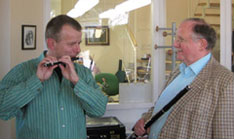
2010
Since the two musicians played in two completely differently oriented orchestras, they provided Anton J. Braun with insights into their respective requirements. The art lay in balancing these different demands: their feedback flowed directly into the development process to create an instrument capable of unfolding the required tonal character in any of these musical contexts.
1998
Since 2015, her husband,Dipl.-Geol. Ludwig Simon (Precision Mechanics & Materials Technology), has been working by her side, enriching the traditional craft with an additional scientific component.
Having been introduced to the subtleties of flute making by his father-in-law, he practices the craft today alongside his wife, linking this foundation with his own family roots in precision mechanics.
In 2026, after 25 years of her active collaboration, Anton J. Braun handed over the leadership of the business to his daughter, Eva-Marie Simon.
She and her husband are leading the family business into the next generation, carrying the torch of tradition forward.
2020
2026

Egelsbach, In den Obergärten 22
Family tree
Violin making in Austria-Hungary
"Where the violin plays such a significant role, one may assume that there are and have been not only artists who know how to play this precious instrument, but also those who understand how to build it."
Dr.Gunther Joppig M.A. / Director of the Musical Instrument Museum at the Munich Stadtmuseum.
( From the foreword to Peter Benedek's "HUNGARIAN VIOLIN MAKING")
|
Anton Braun (Senior) Tischler ( 1832 - 1904 ) Mako / Österreich-Ungarn |
||

|
||
|
Anton Braun Geigenbauer ( 1877 - 1927 ) Firmengründer in Temesvár 1896 |
Michael (Mihály) Braun Geigenbauer ( 1870 - 1942 ) Kolozsvár / Österreich-Ungarn |
Johann (János) Braun Geigenbauer ( 1860 - 1922 ) Szeged / Österreich-Ungarn |

|
Preis-Medaillen von Gewerbe Ausstellungen
|
|
|
Anton Michael Braun Blasinstrumentenmacher ( 1911 - 1978 ) Temesvár / Österreich-Ungarn |
Johann Bruno Braun Geigenbauer ( 1905 - 1968 ) Temesvár / Österreich-Ungarn |
|

|
||
|
Dipl.-Ing./R. Anton J. Braun Maschinenbau und Instrument Konstrukteur (* 1941 ) Timisoara / Rumänien seit 1977 in Deutschland |
LITERATUR
 Peter Benedek "HUNGARIAN VIOLIN MAKING" Peter Benedek "HUNGARIAN VIOLIN MAKING"Documentation of the instruments exhibited in 1995 at the Munich Stadtmuseum, featuring the world's most famous and important Hungarian violin makers. ISBN-13 : 978-3981719123 Lyndesay G.Langwill "AN INDEX OF MUSICAL WIND-INSTRUMENT MAKERS" Fifth Edition 1977Auguste Bosc "MUSIQUE ADRESSES UNIVERSEL" Paris 10 Édition 1928 |
|
|
|
||
|
Eva-Marie A. Simon Holzblasinstrumentenmacherin (* 1980 ) Egelsbach / Deutschland |
Dipl.-Geol. Ludwig Simon Feinmechanik & Materialtechnologie (* 1981 ) Budapest / Ungarn |
|
 | ||
|
Sohn & Tochter |
||
